A concise guide to MAV 3.0
Introduction
The new route is divided into 7 sections :
I. An area consisting of the Installation of De Kerkhove, the registry office of ancient Herculaneum and the excavation interactive map.
2. An area dedicated to the EXCAVATION that reproduces the Bourbon tunnels and where some interactive installations can be found
3. The area of the city dedicated to PUBLIC PLACES (thermal baths, Theater, Schola Armaturarum, Forum, Temple of Jupiter), where the social activities of the ancient Pompeii and Herculaneum took place
4. The area dedicated to DOMUS, with examples of virtual reconstructions of some of the most important Roman buildings.
5. The area dedicated to LEARNING with the installations at Villa dei Papiri.
6. The area dedicated to PLEASURES with brothel and erotic frescoes of Pompeii.
7. The area dedicated to the Eruption of Vesuvius in 79 AD.
THE FACES AND THE HISTORY
OF ANCIENT HERCULANEUM
By entering this room, on the left you can see
the name list of the inhabitants of Herculaneum, found in the Forum of the
city. This is the first example of registry. Examining statues, carvings and
frescoes, the use of computer graphic allowed us to give faces to those names.
Next to the names and faces of the ancient Herculaneum, we succeeded in drawing
a map of the ancient Herculaneum. Here, through an interactive device and the
touch screen, you can get an overview of the most significant attractions of
the city, as it has been rediscovered by the excavations , then you can read the
captions of each monument and of the domus
to get ready to the visit.
THE EXCAVATION
The eruption of Vesuvius in 79 d.c. buried Herculaneum under a blanket of mud and ash that
solidified into a compact layer over 20 meters high. If, on the one hand, all this has made the operations of excavation difficult, on the other, it has allowed the preservation of highly perishable materials such as papyrus, food and wood until today.
The existence of the ancient Herculaneum was revealed accidentally in 1709 by the Duke
d 'Elbouf, a noble man living in Portici. He learned that during the excavations for the construction of a well in the garden of a local farmer, they had stumbled upon the remains of
an old building, later found out as the theater of Herculaneum. The official date of the beginning of excavations at Herculaneum is the 1738; they used the technique of underground tunnels and ventilation shafts. Since then, after ten years, they started with the exploration of ancient Pompeii and Oplontis.
THE PUBLIC PLACES OF THE ROMAN TOWNS
· THE THEATRE OF HERCULANEUM
Three hundred years ago the theater was the first building of ancient Herculaneum to be identified during the excavation of a pit for water extraction. In 1710 the farmer Ambrogio Nocerino came across the theater stage during his own dig, from there he carried off the marble and statues. This date also marks the rediscovery of the ancient Herculaneum, destroyed by the eruption of Vesuvius in AD 79 and its proper exploration began in 1738, by order of Charles of Bourbon, precisely from this building. The theater was built in the Augustan era and we also know the architect’s name who designed it, P. Numisius. The building, one of the best preserved Roman theatres, was explored through tunnels during the Bourbon excavations and it still lies buried under a blanket of volcanic layer more than 20 meters thick, on which some buildings were built. It consists of a hemicycle of more than 50 m, vertically divided into three sectors (summa,media and ima cavea), where about 2,500 people could be seated.
· THE CENTRAL THERMAL BATHS
The baths date back to the age of Augustus, and were made up of two parts, one reserved for men and the other to women. The complex of the central thermal baths had a key public function, because it met the need of people to wash accurately , since the current water was a privilege for a few. In fact there had access people from all social classes, at different times and at a very low cost, accessible to most citizens. The baths also played an 'important social function: there people talked about business or met friends, practiced Gymnastics and relaxed their spirit and body from daily work.
·
THE FORUM
The Forum was the central square of Pompeii,
closed to the transit of the wagons, and was the place where the activities
were concentrated, the civil, commercial, religious and political
administration of the city. Between the end of the first century B.C and the beginning
of the first century A.D. some structural reconstructions were made: the ancient
irregular shape was turned into a rectangular one, the floor was remade first of tuff and then of travertine marble. Along the
perimeter, delimited by a columnade facing buildings of all kinds, there were shops
and taverns, in accordance with the public function of the square.
THE DOMUS
The House of the Tragic Poet: the most prestigious domus of Pompeii, famous for the mosaic Cave Canem. Despite its small size, this house is one of the most elegant and richly decorated in Pompeii. Domus in Italic style, with the most important compartments along the same axis, with a Tuscan atrium. The building is located in the Regio VI northern boundary of the city, probably belonging to a certain Anino, member of one of the emerging families in the new senatorial class in Pompeii. Built in the 1st century B.C., but the decoration was entirely rebuilt after the earthquake in 62 AD. C. It owes its name to the mosaic decoration depicting the Rehearsal of a satyr chorus, found in the house and now displayed in the Archaeological Museum of Naples.
House of Citharist This installation is one of the innovations of the exihibition. It is the first time that the Citharist House has been reconstructed in 3D computer graphics. The house originated from the fusion of two houses in the first century B.C. for which it has two atria, three peristyles with a total area of 2700 square meters. The oldest part is the bottom, which overlooks Via Stabiana, with an atrium and two Tuscan peristyles, replacing the demolished houses.
House of the Faun
The House of the Faun is the most important and noble home come down from Roman times. Its luxury style gives us the measure of the extraordinary richness of the Roman noble class of the 2nd century A.D. Its extension was about three thousand meters and it was built with advanced construction techniques in 120 BC. We do not know the owner’s name, but its
denomination is due to the bronze statue portraying a dancing faun in the center of the impluvium in the mansion.
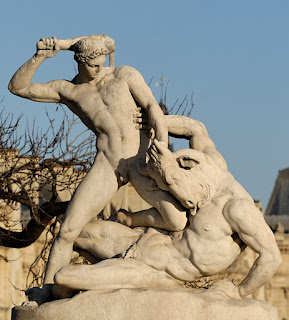
The House of the Labyrinth is a domus of Pompeii, built largely in the Republican period. The house is located in Regio VI Insula 11, 9.10 and takes its name from the presence of a mosaic depicting the labyrinth and the fight between Theseus and the Minotaur. This house fits the "atrium" style.
The VILLA of the PAPYRI
The Villa of the Papyri is one of the largest and most luxurious Roman residences, brought to light by the excavations in Bourbon era, between 1750 and 1764. It extends under the present town, about thirty meters deep, reaching the sea. The building keeps the extraordinary collection of works of art; the villa excavation yielded a very important library of papyri.
The exploration was through a network of tunnels that were dug in the hard volcanic rock bench, under the Swiss engineer’s direction , Karl Jakob Weber, who also released an accurate map of the villa.
Villa dei Papiri was the summer residence of Lucius Calpurnius Piso, father of Giulio Cesare and man of letters, who protected poets and philosophers. In this section you can see the reconstruction of the villa overlooking the sea, the peristyle with a large pool and
the statues that adorned it, tablinium and library with school and reading scenes.
PLACES OF PIACERE : “ LUPANARE”
The term derives from the Latin word ,brothel prostitute” Lupa”: it was the site of Pompeii where prostitutes offered their sexual services.
On the ground floor there are five rooms, and an outhouse: the beds, in stonework, were covered by the mattress. Small paintings, depicting the different positions to be taken in the coupling games, adorned the lupanare.
THE ERUPTION OF VESUVIUS Upstairs, in the hall of virtual theater, you can watch the film in 3D on the eruption of Vesuvius in 79 AD. C. realized in collaboration with the National Institute of Geophysics and Volcanology, starting from the story made by Pliny in his letters to Tacitus. The students can understand what happened over 2000 years ago, which has given us a unique archaeological heritage in the world.
Commenti
Posta un commento